
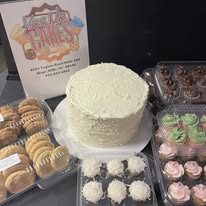
Start with expected attendance, decide whether cake is also being served, and define whether guests may choose one dessert or sample several. Quantity depends on portion size, variety, event length, age mix, meal timing, and how the table will be replenished—not guest count alone.
Decide what role the dessert table plays
A dessert table can be the main sweet course, a supplement to cake, a reception display, or a take-home station. Each role creates a different quantity target. If cake already covers every guest, the table may focus on variety. If there is no cake, the table must carry the full serving need.
Tell the bakery whether guests will be invited to sample freely or limited to one packaged item.
Count portions, not just products
A full-size cupcake, mini dessert, cookie, brownie, cheesecake portion, and cake slice are not equivalent. Ask about actual product size before using an online formula. A table with 100 pieces may be generous or insufficient depending on what those pieces are.
Create a list with each product, portion size, and quantity. This exposes gaps and prevents a visually full table from hiding too few practical servings.
Use a three-layer quantity plan
- Guaranteed servings: enough dessert for every guest who must be served.
- Choice allowance: extra pieces that let guests choose among varieties.
- Buffer: a controlled amount for unexpected guests, damage, seconds, or host leftovers.
Keep these layers separate. Otherwise, “variety” can quietly become expensive overordering.
Variety should be intentional
More varieties do not automatically improve the table. Every added option divides the quantity and creates another item that can run out unevenly. Choose a manageable mix of familiar and distinctive flavors, textures, and formats.
For example, cake plus cupcakes plus cookies may provide enough contrast without adding several similar bars and mini cakes. Ask what the bakery currently offers and which items can be produced consistently for the event size.
Account for children, meal timing, and event length
Children may choose visually exciting individual desserts, while adults may prefer smaller portions after a full meal. Afternoon open houses can produce repeated grazing. A short seated dinner creates a more controlled dessert moment.
Describe the schedule: when food is served, when the dessert table opens, how long guests remain, and whether containers are available for take-home items.
Plan the display and replenishment
Putting every dessert out at once can create crowding, warming, drying, or uneven consumption. A smaller display with safe replenishment may protect quality. Confirm which items require refrigeration and who will manage the table.
Use labels when products look similar or contain ingredients guests may ask about. Do not make allergy-safety claims unless the bakery has provided accurate information.
Dessert-table planning worksheet
- Expected guest count
- Adults and children
- Whether cake is served
- Cake servings already covered
- Main meal or light refreshments
- Full-size or mini portions
- Number of dessert varieties
- One-per-person or sampling format
- Event length
- Refrigeration and replenishment plan
- Desired leftovers or strict waste control
- Take-home packaging
How to brief Kiss Me Cakes
When you visit the Kiss Me Cakes bakery website for Hope Mills, provide the event date, guest count, cake plan, desired dessert types, serving style, venue conditions, and whether you want leftovers. Ask for the size and quantity of each item in the proposed order.
Online formulas cannot guarantee quantities for actual products. Final portions, availability, pricing, pickup, storage, and product selection must be confirmed directly with Kiss Me Cakes.
Common dessert-table questions
Should I order one dessert per guest?
Not necessarily. The right number depends on whether cake is served, the portion sizes, whether guests sample multiple items, and the event format.
How many varieties should I offer?
Choose enough variety to create meaningful choice without dividing quantities into too many small groups. Three or four coordinated formats may be stronger than a scattered table.
Can I put everything out at once?
That depends on space, temperature, food-safety needs, and event length. Plan a replenishment method when appropriate.
Use a sample quantity worksheet
For 60 expected guests, start by deciding whether cake covers all 60, only part of the group, or none. Then list each additional dessert by actual portion count. If the plan allows every guest to sample two items, the total pieces must support that behavior—not merely match the head count. If guests are expected to choose one item, signs or staff guidance may be needed so the first group does not take several pieces.
Run the same plan for the expected count, a lower attendance case, and a reasonable high case. That reveals whether the buffer is controlled or whether the order depends on everyone eating exactly as predicted.
Coordinate the dessert table with cake service
Use the cake serving-size guide to estimate the cake’s role, then compare formats with the cake, cupcakes, cookies, or dessert-table guide. These decisions should be made together, not as separate orders.
Control waste without creating a shortage
Decide in advance what should happen to leftovers. Some hosts want take-home boxes, while others need the table cleared immediately after the event. Assign containers, labels, and a responsible person before dessert service begins. This makes a modest buffer useful instead of wasteful.
For large community or workplace events, keep a small reserve off the main table and replenish only when needed. That protects presentation, reduces handling, and gives the host better control over the final portions.